A Guide to Tarot Court Cards for Clearer Readings
Court cards are often where an otherwise clear tarot reading becomes uncertain. A spread may show a Queen of Swords beside a career question, or a Knight of Cups in a relationship reading, and the immediate question is: is this a person, a personality trait, or an event about to unfold? A useful guide to tarot court cards begins by accepting that the answer can be more than one thing.
Court cards are not labels to place carelessly on people. They are patterns of energy, behavior, maturity, and social roles. Read with context, they can bring meaningful clarity to how someone is showing up, what a situation requires of you, or what quality is growing within you. Read too literally, they can encourage assumptions. The difference is discernment.
What Tarot Court Cards Represent
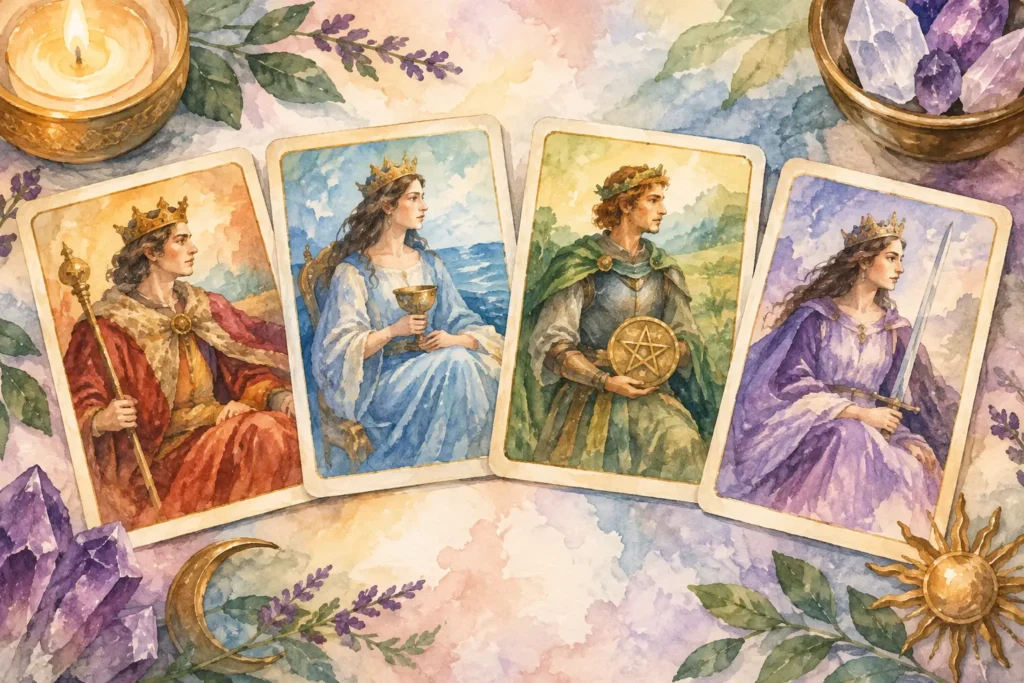
Every suit has four court cards: Page, Knight, Queen, and King. Together, they show four distinct ways that the suit’s element can be expressed. They may describe a recognizable person, but they can also point to the querent’s present approach, an influence in the environment, a role they are being asked to take on, or a stage of development.
The suit tells you the territory of life involved. Wands speak to motivation, creativity, confidence, and action. Cups concern feelings, connection, imagination, and relationships. Swords address thought, communication, truth, conflict, and decisions. Pentacles relate to work, money, the body, practical resources, and steady effort.
The rank tells you how that territory is being handled. Rather than treating a court card as a fixed demographic description, begin with the rank and suit. This creates a reading that is both more accurate and more respectful of the individual involved.
Pages: The Beginning of a Message or Skill
Pages carry curiosity, openness, and the early stages of learning. They can indicate news, an invitation, a new interest, or a person who is exploring a quality without fully mastering it yet. Their energy is sincere, but it may be untested.
A Page of Pentacles in a career reading may suggest a promising training opportunity, a practical new idea, or the need to take a beginner’s mindset toward finances. In a relationship reading, the Page of Cups can point to emotional honesty, a tender message, or feelings that are real but still finding their language.
Pages are sometimes dismissed as immature. That is too narrow. Their gift is willingness. They remind you that competence often starts with paying close attention and asking a better question.
Knights: Movement, Pursuit, and Momentum
Knights take the suit’s energy into motion. They often show pursuit, travel, change, or a decision that is gathering speed. Whether that movement is helpful depends on the suit and the surrounding cards.
The Knight of Wands can bring courage, attraction, and a willingness to act. It can also caution against acting before the practical details are clear. The Knight of Swords may describe direct communication and strong conviction, but alongside cards of tension, it may suggest arguments, pressure, or rushed choices.
When a Knight appears, ask what is moving, who is driving that movement, and whether the pace serves the situation. Not every opportunity needs an immediate answer. In sensitive matters involving work, money, or commitment, momentum should be balanced with sound judgment.
Queens: Inner Authority and Emotional Intelligence
Queens tend to express the suit through presence, perception, and stewardship. Their strength is not passive. They understand what needs care, boundaries, cultivation, or patient attention.
The Queen of Cups may reflect deep empathy, intuition, and emotional availability. She can also be a reminder not to absorb everyone else’s feelings. The Queen of Swords is clear-minded, honest, and discerning. In a difficult conversation, she encourages a person to say what is true without becoming needlessly harsh.
A Queen can represent someone influential in the reading, but it often signals an inner capacity the querent already has or needs to develop. If the question concerns a choice, the Queen may be asking: what would a self-respecting and emotionally steady response look like here?
Kings: Direction, Responsibility, and Mature Expression
Kings show command of the suit’s energy. They are associated with direction, responsibility, decision-making, and the ability to create order. Yet mature authority is not the same as control. A King at his best leads with accountability; at his most difficult, he may become rigid, overly certain, or detached from the human impact of his choices.
The King of Pentacles can indicate reliable financial or professional leadership, long-term planning, and a preference for tangible results. The King of Wands brings vision and initiative, often when a person needs to lead rather than wait for permission. The King of Cups may suggest emotional composure during a charged period, while the King of Swords asks for facts, standards, and a decision grounded in reason.
A Practical Guide to Tarot Court Cards in Context
Before deciding that a court card is a specific person, look at the question asked. If someone asks, Should I accept this role?, a King of Wands is more likely to describe the leadership required than a stranger who will appear. If they ask, What is affecting this relationship?, the same card may reflect a partner, mentor, family member, or an existing dynamic around independence and control.
The neighboring cards matter just as much. A Page of Cups surrounded by supportive Cups may show a genuine emotional opening. Beside the Seven of Swords, it could suggest someone withholding feelings, avoiding directness, or presenting themselves as more innocent than they are. Tarot works through combinations, not isolated definitions.
It also helps to distinguish between a card’s healthy and strained expression. The Queen of Pentacles can be generous, capable, and grounded. Under pressure, that same energy can overfunction, carrying responsibilities that should be shared. The goal is not to decide that a card is good or bad. It is to identify the pattern and its practical implication.
How to Recognize a Person Without Making Assumptions
A court card is more likely to describe another person when the question specifically concerns a relationship, team, family, or decision-maker. Repeated court cards, strong visual connections between cards, and a clear match with the person’s current behavior can reinforce that interpretation.
Still, avoid using physical appearance, gender, age, or astrological correspondences as proof. These associations can be useful prompts in a deeper study practice, but they are not reliable shortcuts. A King does not have to be a man, a Page does not have to be young, and a Queen of Swords does not automatically mean a difficult person.
Instead, describe the observable dynamic. You might say that someone is communicating with Queen of Swords qualities: candid, perceptive, and protective of their boundaries. That is more useful than assigning a permanent identity. It leaves room for complexity, change, and the querent’s own lived knowledge.
Questions That Make Court Cards More Useful
When a court card appears, pause before reaching for a memorized meaning. Ask whether it is showing a person, a role, a quality to embody, or an influence that needs to be managed. Then ask what the suit reveals about the area of life involved and what the rank reveals about the level of maturity or movement.
For decision-making, one final question is especially valuable: what is the most grounded expression of this card? The Knight of Pentacles may advise steady follow-through. The Queen of Cups may call for compassion with boundaries. The King of Swords may ask you to clarify terms before making a commitment. This turns tarot from a vague prediction into practical reflection.
Court cards become less intimidating when you stop trying to force them into one identity. Let them describe the quality of the moment first. From there, the person, lesson, or next step often becomes clear with quiet precision.