Tarot or Therapy Differences That Matter
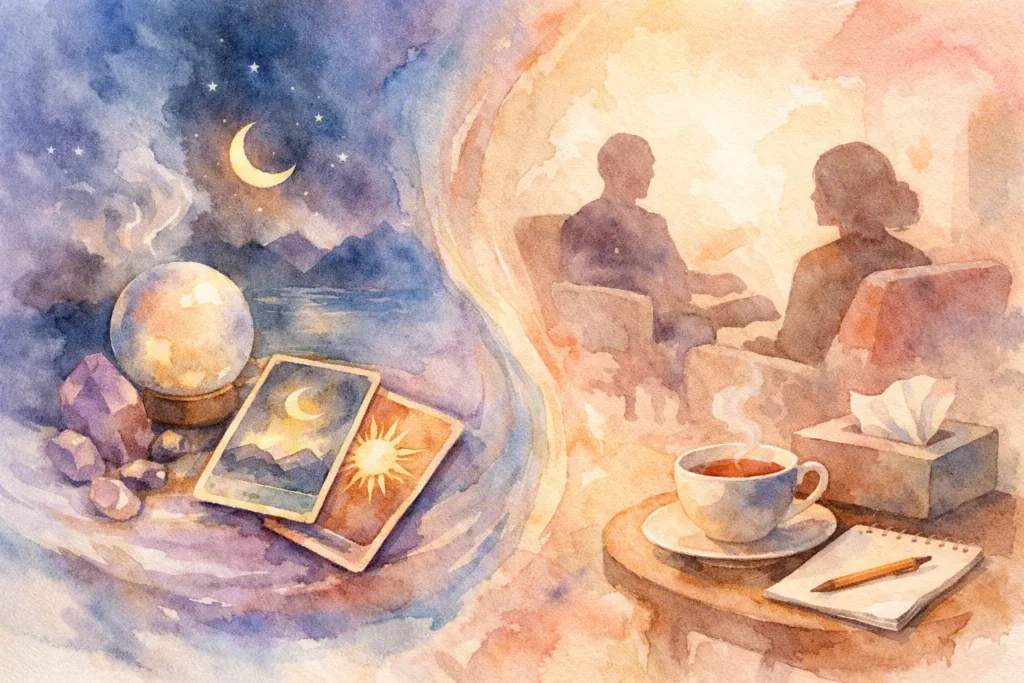
A surprising number of people ask the same quiet question before booking a session: do I need tarot, or do I need therapy? The confusion is understandable. Both can involve honest conversation, emotional reflection, and a search for clarity. But the tarot or therapy differences are real, and knowing them helps you choose support that actually fits your situation.
For some people, the choice is not either-or. A tarot consultation and therapy can sit side by side very well when each is used for its proper purpose. The key is understanding what each modality is designed to do, where its limits are, and what kind of guidance you are truly seeking.
What tarot is meant to do
Tarot is a reflective and interpretive tool. In a grounded professional setting, it is used to bring insight to a question, a pattern, or a decision point. A reading may help you notice what is influencing a relationship, where your energy is being divided, what fear is shaping your choices, or what timing around a situation appears to be developing.
That means tarot is often most useful when life feels unclear but not necessarily clinically unsafe. You may be weighing a job move, wondering whether a connection has long-term potential, trying to understand repeated setbacks, or sensing that a chapter is changing before the external facts fully catch up. Tarot can offer perspective, language, and emotional distance. It can help you see the shape of a situation more clearly.
A responsible tarot reader is not acting as a licensed mental health provider. The role is different. The work is not diagnosis, psychiatric treatment, or trauma therapy. It is guidance, interpretation, and decision support delivered with ethics and discretion.
What therapy is meant to do
Therapy is a clinical or therapeutic process provided by a licensed mental health professional or trained counselor, depending on the setting and credentials. Its purpose is to support psychological well-being, emotional regulation, behavior change, trauma recovery, and mental health treatment.
If you are dealing with depression, panic, debilitating anxiety, unresolved trauma, compulsive behavior, grief that is impairing daily function, or relationship patterns tied to deeper attachment wounds, therapy is not optional support. It is often the more appropriate form of care.
Therapy usually works through established psychological methods. It may involve exploring your history, identifying cognitive patterns, developing coping skills, processing trauma, or building healthier responses over time. The focus is not prediction. It is treatment, healing, and mental health support.
Tarot or therapy differences in real life
The easiest way to understand tarot or therapy differences is to look at the core question each one answers.
Tarot often asks, what is happening here, and what should I understand before I act?
Therapy often asks, why am I responding this way, and how can I heal or function better over time?
That distinction matters. If you are asking whether to leave a job, tarot may help you read the emotional and practical dynamics around the decision. Therapy may help you understand why every authority figure triggers fear, or why uncertainty sends you into shutdown.
If you are asking about a romantic relationship, tarot may highlight the current emotional truth, mixed intentions, repeating cycles, or likely direction if nothing changes. Therapy may help you work through abandonment wounds, conflict patterns, or low self-worth that affect the relationship choices you make.
One offers insight into a situation. The other helps build long-term psychological change. Sometimes you need one clearly more than the other. Sometimes you need both.
Where people confuse the two
Confusion usually happens because a good tarot session can feel emotionally relieving. You feel seen. You feel calmer. You finally have words for something that has been difficult to name. That can be powerful, but emotional relief is not the same as therapy.
A tarot reading may validate your intuition and bring immediate clarity. It may even help you interrupt a spiral by bringing structure to confusion. But if the same fear, trauma response, or emotional collapse returns every week, insight alone may not be enough. Repeated clarity without deeper treatment can become a loop.
The reverse also happens. Some people enter therapy hoping the therapist will simply tell them what to do about a person, a career path, or a turning point. Good therapy does not usually work that way. It is less about direct answers and more about helping you develop the internal capacity to make healthier decisions.
So when clients compare the two, the better question is not which one is better. The better question is what kind of support your current problem actually requires.
When tarot may be the better fit
Tarot is often well suited to crossroads moments. You are functional, reflective, and capable of making decisions, but you need perspective. You want to understand the dynamics around a choice rather than process a mental health crisis.
This may be the case when you are considering a job change, trying to assess a relationship’s direction, timing a major move, or making sense of repeated external patterns. In these situations, a clear tarot consultation can be practical. It can help you slow down, see what you are missing, and make a more informed choice without fear-based messaging.
Tarot can also be helpful for people who are spiritually open but still value structure. When the reading is conducted ethically, the goal is not dependency. The goal is clarity that supports your own judgment.
When therapy may be the better fit
Therapy is the better choice when distress is affecting your ability to function, regulate, or feel safe. If your relationships repeatedly involve abuse, if your anxiety is affecting sleep and work, if grief is overwhelming, or if trauma is being activated in ways that feel destabilizing, clinical support matters.
It is also the better fit when you want to work through long-standing patterns rather than interpret one current situation. Therapy is built for repetition, depth, and structured emotional change. It creates a container for healing that tarot is not meant to replace.
If there is any concern around self-harm, severe depression, addiction, or psychiatric symptoms, the right next step is mental health care. A responsible spiritual advisor should say so clearly.
Can tarot and therapy work together?
Yes, and often very well.
A therapist may help you process the emotional roots of your people-pleasing, while tarot helps you examine a current decision where that pattern is active. Therapy may support trauma recovery over months, while tarot offers occasional perspective during a career shift, breakup, or major life transition.
The combination works best when roles are clear. Therapy handles treatment and emotional repair. Tarot offers symbolic insight, situational clarity, and reflection. Neither needs to imitate the other.
For thoughtful clients, this can be a balanced approach. You do not have to flatten spiritual tools into clinical ones, and you do not have to expect therapy to answer every practical or intuitive question.
Ethical signs to look for
Whether you choose tarot or therapy, ethics matter more than promises.
A good therapist does not create dependency or shame you for struggling. A good tarot reader does not use fear, inflated certainty, or dramatic predictions to keep you coming back. Both should respect boundaries, communicate clearly, and leave you more grounded, not more panicked.
This is especially important when you are vulnerable. During heartbreak, uncertainty, or major transitions, people are more susceptible to urgent messaging and exaggerated claims. Calm guidance is usually the safer sign. Professional ethics are not a bonus. They are part of the service.
Practices like Ask Kay are built around that principle: grounded intuition, privacy, and practical clarity rather than spectacle. That difference is often what helps clients feel safe enough to hear the truth of their situation.
How to decide what you need right now
Ask yourself a simple question: am I trying to understand a situation, or am I trying to heal a psychological pattern?
If you need insight around timing, dynamics, choices, or what may be influencing a present situation, tarot may serve you well. If you need treatment, coping support, emotional stabilization, or trauma recovery, therapy is the stronger path.
If the answer is both, that is not a contradiction. It is maturity. Many adults moving through complex seasons need more than one form of support, provided each one is used wisely.
The clearest guidance usually begins with honesty. Not every problem is a spiritual question. Not every pain needs clinical framing. When you choose the right container, the next step becomes much easier to trust.
Sometimes clarity is not about picking sides. It is about knowing what kind of care your life is asking for today.